 Keelwater
Brooks’ sales process:
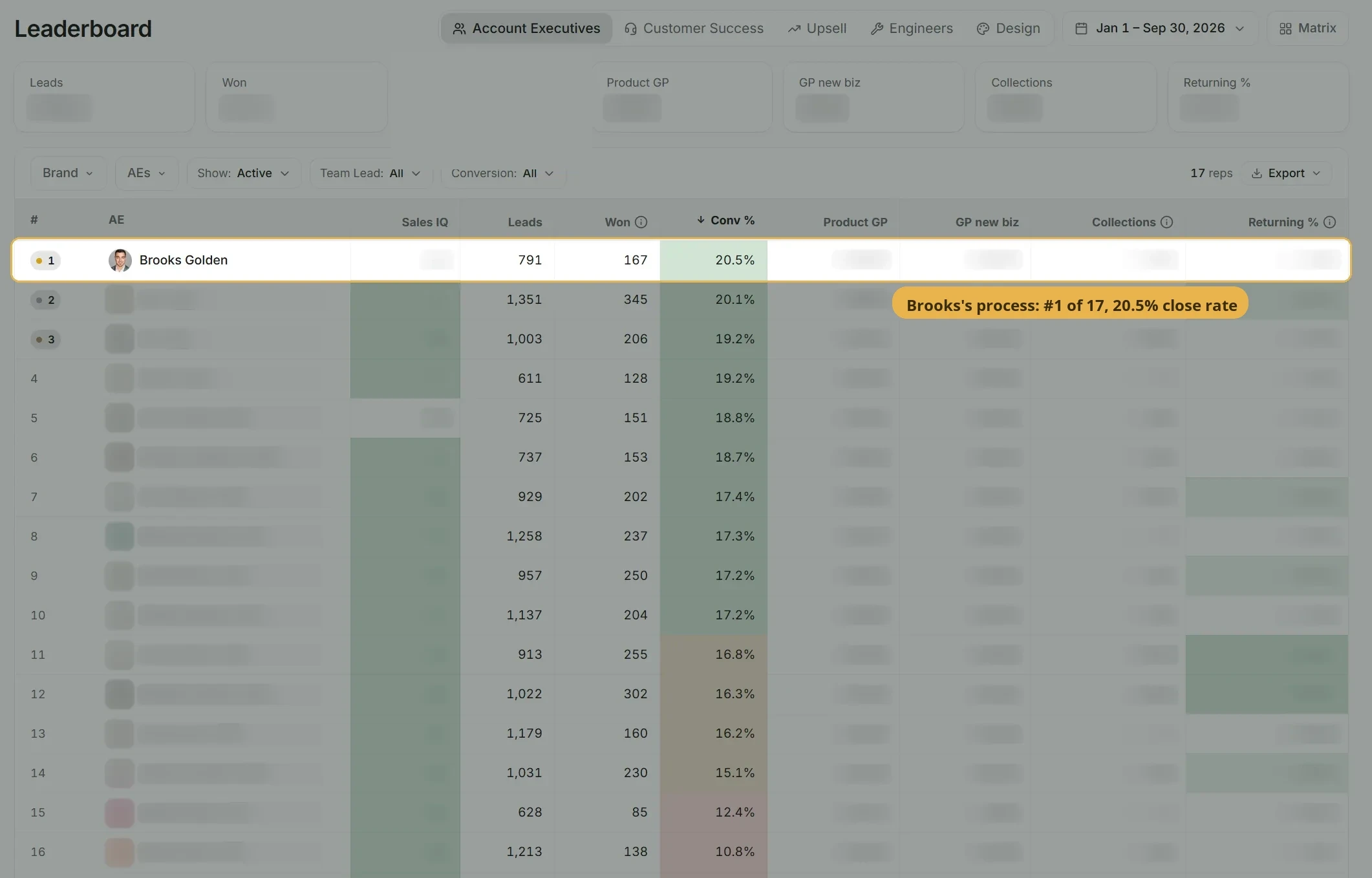
#1 conversion out of 17
2-5 hours of admin saved per day
Brooks Golden built an AI sales process around a CRM with no API access, and managed the team that delivered it. The system answered leads in minutes, drew the customer's product before they asked, filled in the quotes, reminded the team to call, kept the pipeline clean and handed every sale to production. This page walks through each piece, inside the CRM, with the numbers behind it.
 Built by Brooks Golden, founder of Keelwater, and delivered by the made-to-order sales team he managed (branded inflatables). The leaderboard carries his name because he managed the team running his process.
Watch it inside the CRM
February: 13th of 15, and the day ran 10 hours
The job: every inquiry needs a fast, specific reply, a picture of what the customer would be buying, a quote, follow-up until they answer, a phone call, and a clean handoff once they buy. In February, every one of those steps was typed by hand in the CRM, 1 deal at a time, across roughly 100 new leads a month.
The sales seats had no API access. So the system could not be a simple integration. It had to use the CRM the way a person does: through the screen.
Close rate more than doubled
From 10.5% in February to 23.0% in April, the first full month with the system, when the team went from 13th to 1st. The process kept them at or near the top through the summer, while replying faster, sending 4 times as many emails, and working fewer hours.
Close rate is the company's own measure: orders from new customers divided by new leads.
Monthly close rate
Median time to the first reply
The first reply, in minutes, about their project
Speed wins custom work. The system read each inquiry the moment it landed and wrote a reply about the customer's actual project, not a template.
Before
Every inquiry waited for someone to open it, read the form, look at the reference photo and write back. Overnight and weekend leads waited longest. Median wait in February: 24 hours.
What the system does
A sweep checks for new leads every minute from 7:30 am to 9 pm on weekdays. It reads the form, the photo and the deadline, drafts a specific reply, releases overnight leads at 8 am, and reloads the deal to confirm the email really went.
Result
Median wait fell to 35 minutes by July, and 60% of July's inquiries got a reply inside an hour. Customers answered 59% of first replies, up from 37%.
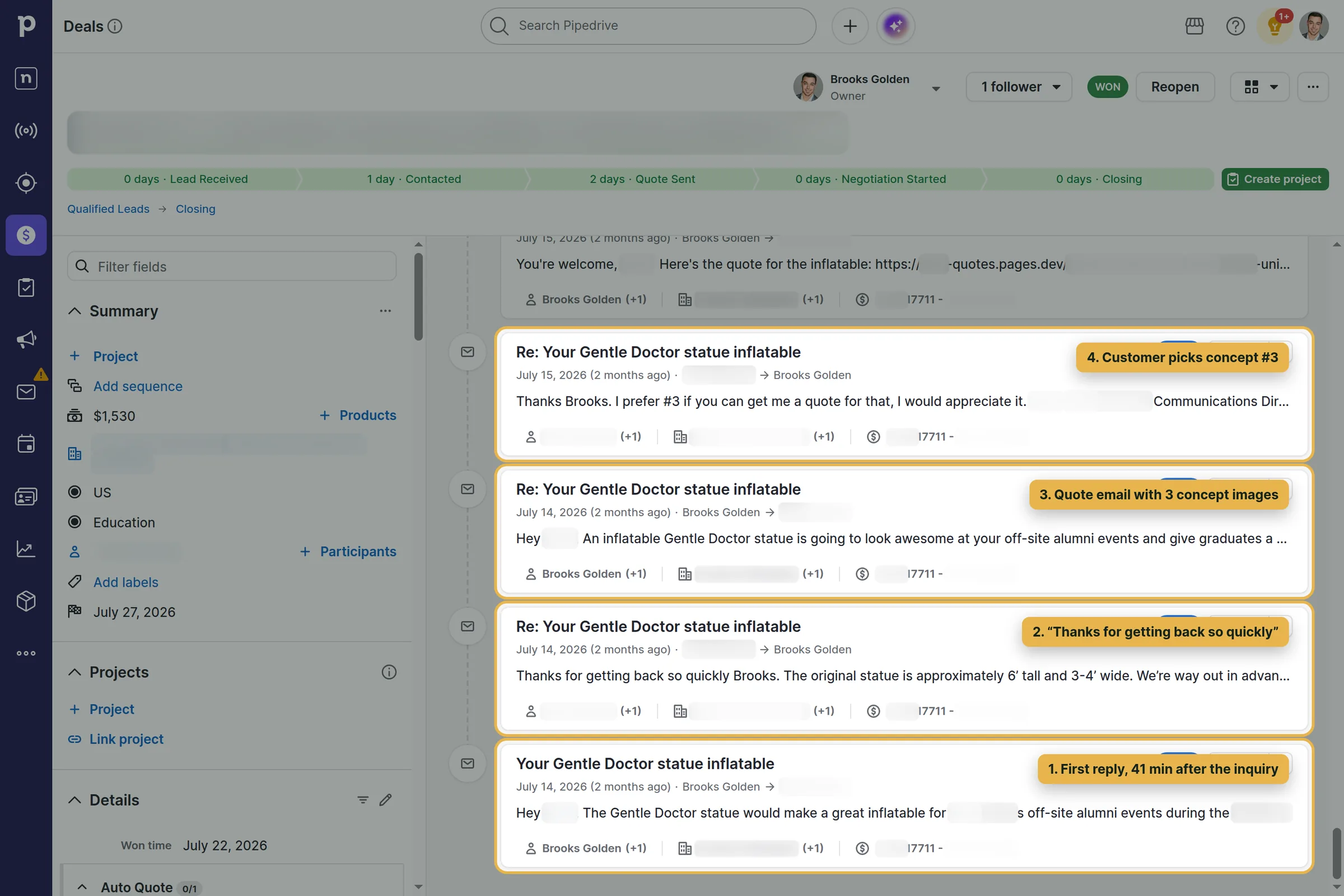
“Frequently they would say, wow, thank you for getting back to me so quickly. It was so good they didn't even know it was AI.”Brooks Golden
A picture of what they're buying, before they ask
“How are you going to buy an inflatable if you don't know what it looks like?” Every quote email carried 3 concepts of the customer's own product, drawn from their form and reference photo.
Before
Describe it in words, or wait days for a designer's mock-up. Deals stalled while the customer tried to picture it.
What the system does
Generates 3 concepts per quote with image models, embeds them in the quote email, and links real photos of similar past projects from a 31-category photo catalog.
Result
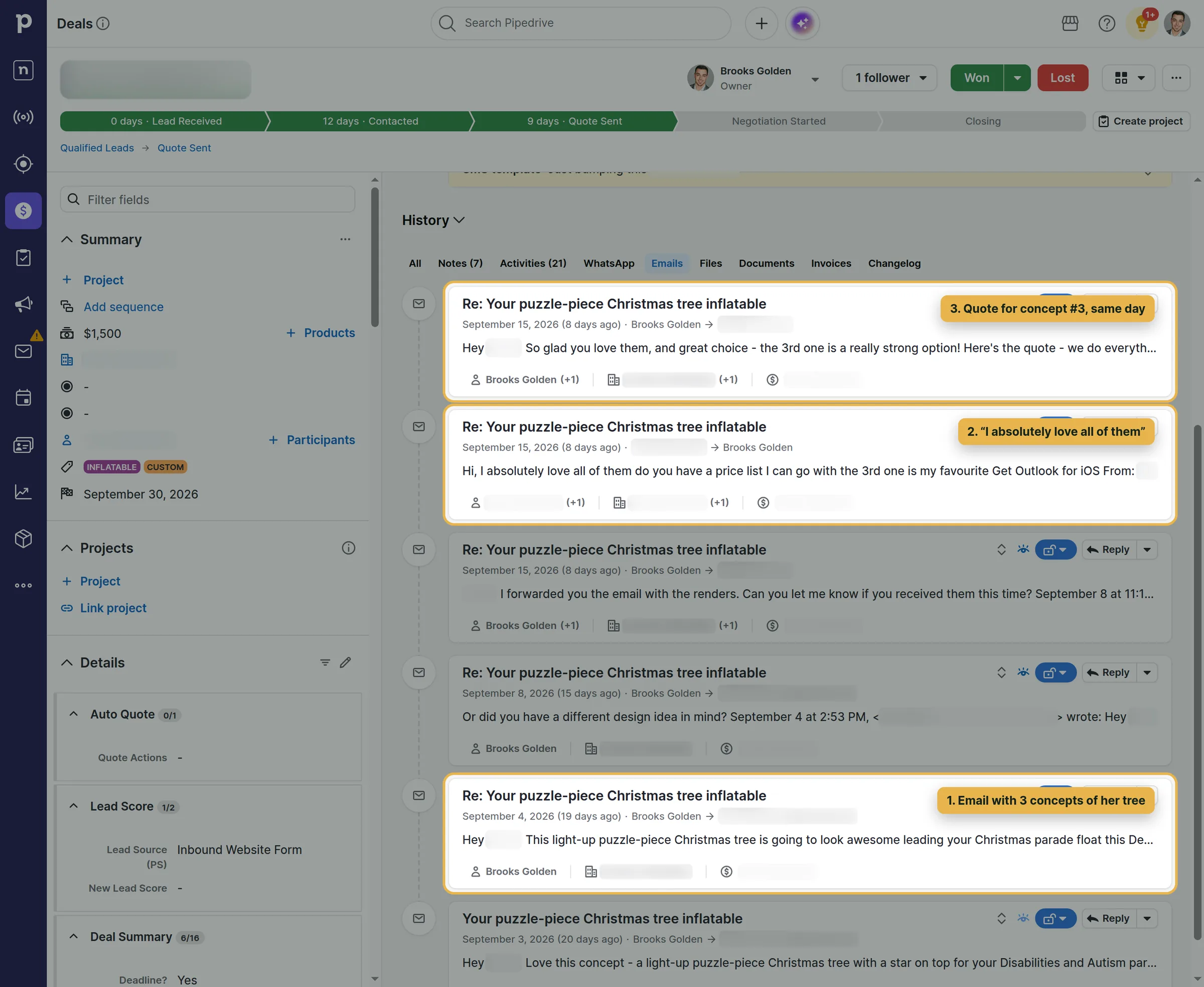
The conversation moves from what it might look like to which one they want. Customers pick a concept by number and ask for the price, as in both deals on this page.
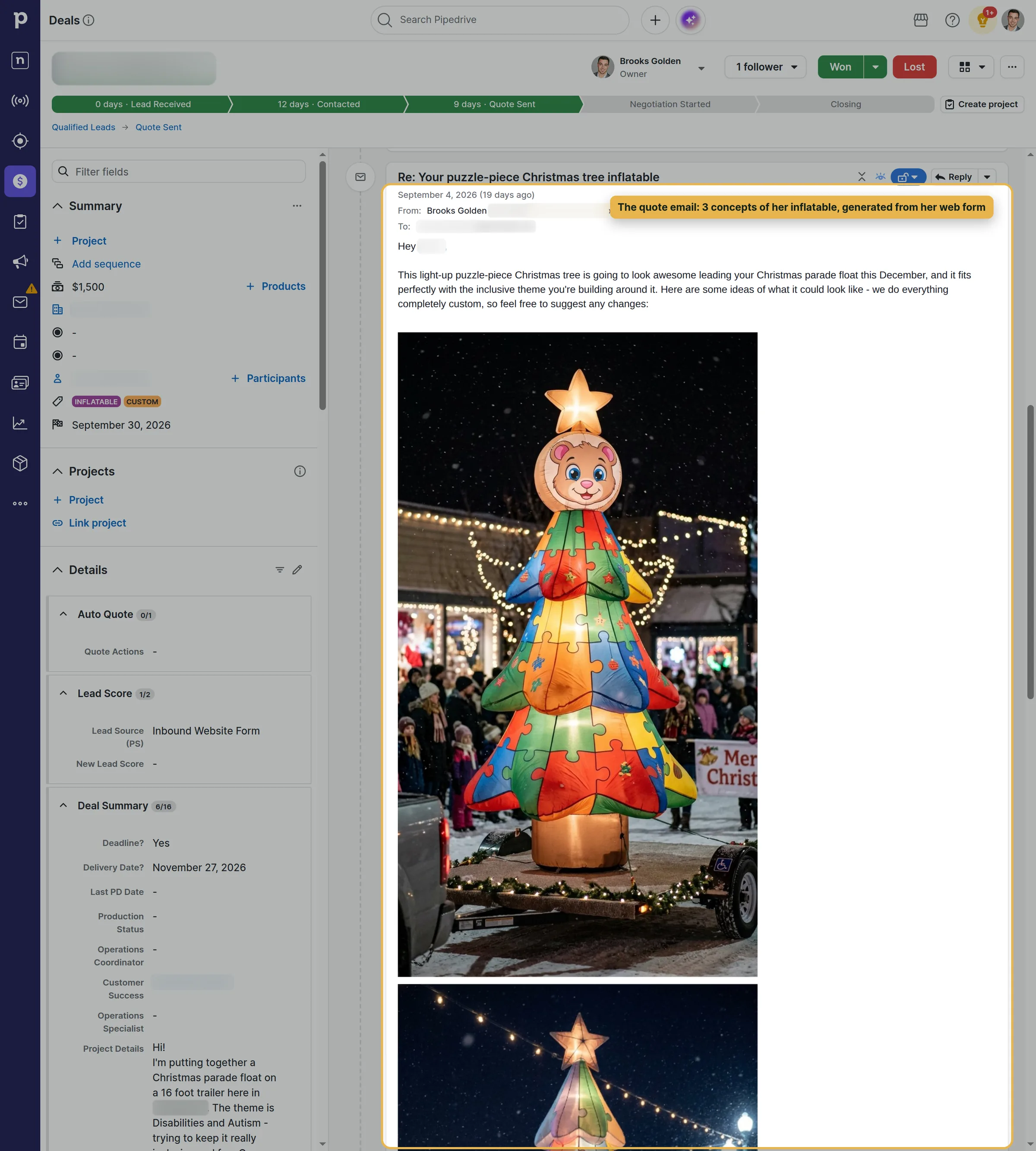
 Concept 1
 Concept 2
 Concept 3 · her pick
Quotes without the line-by-line
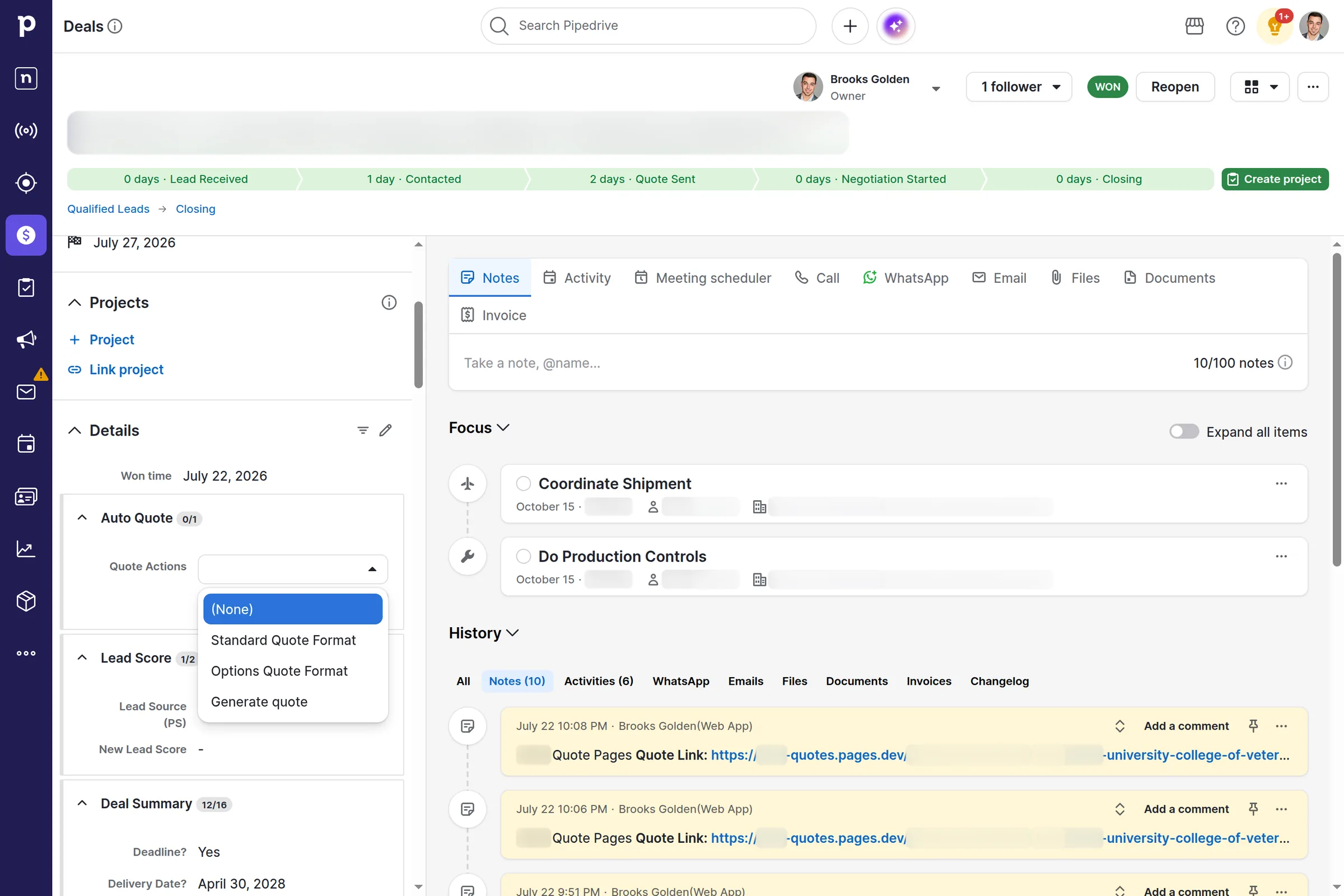
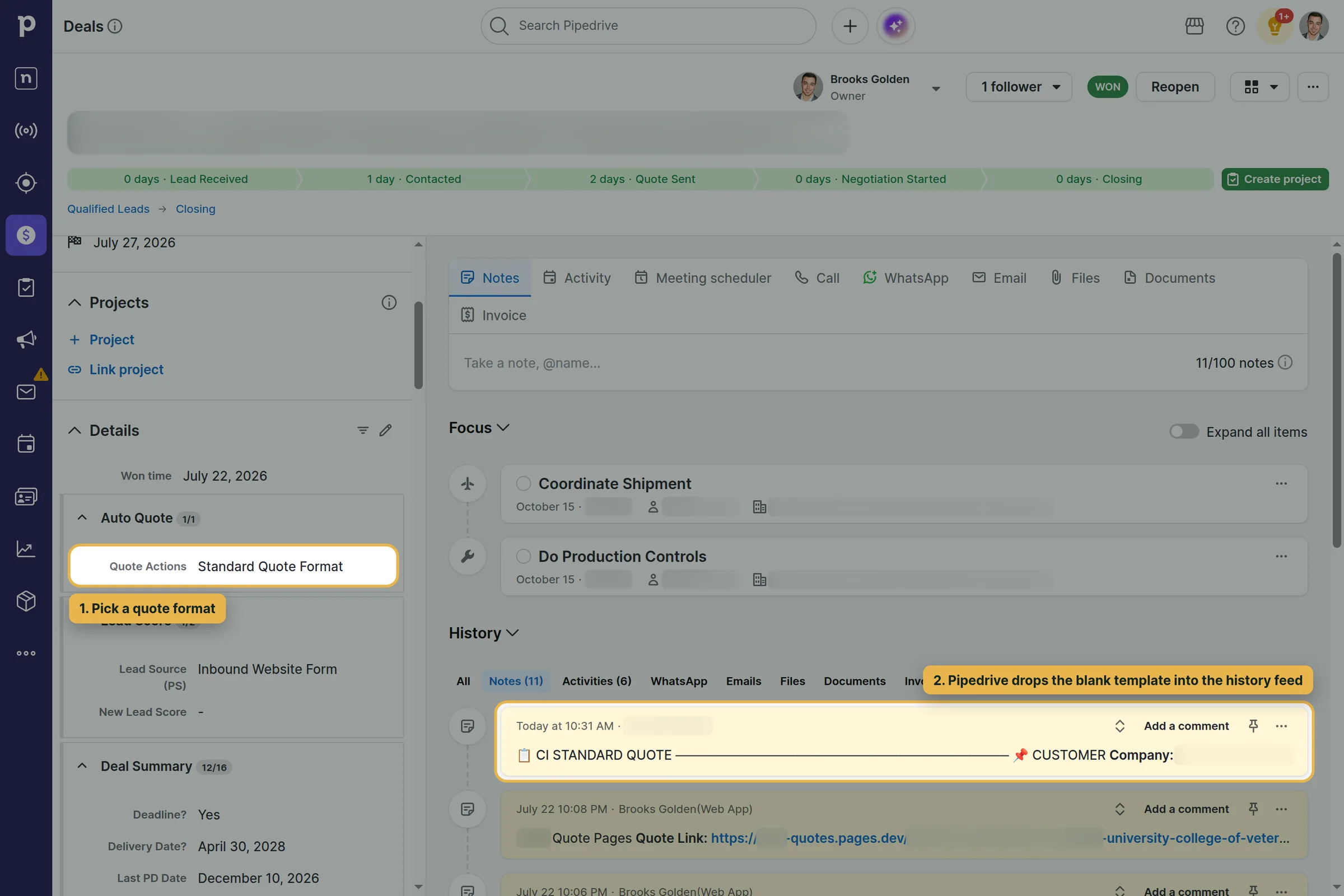
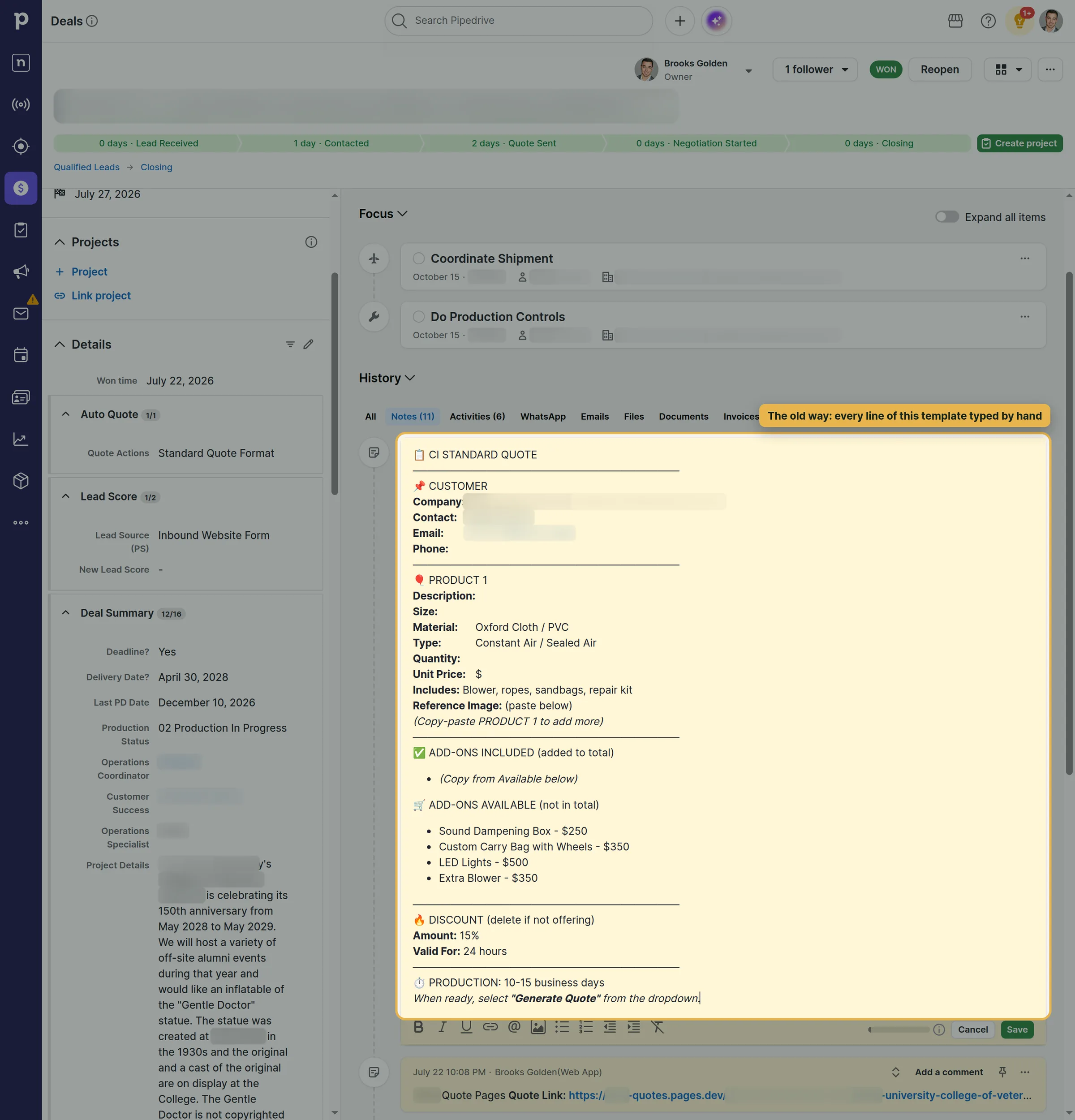
The CRM had an Auto Quote panel: pick a format and it drops a blank quote template into the deal's history. Then someone had to fill in every line. The system fills it.
Before
After each call, 10 to 15 minutes per quote (Brooks' estimate): remember the call, type product, size, material, prices, add-ons and discount into the template, line by line.
What the system does
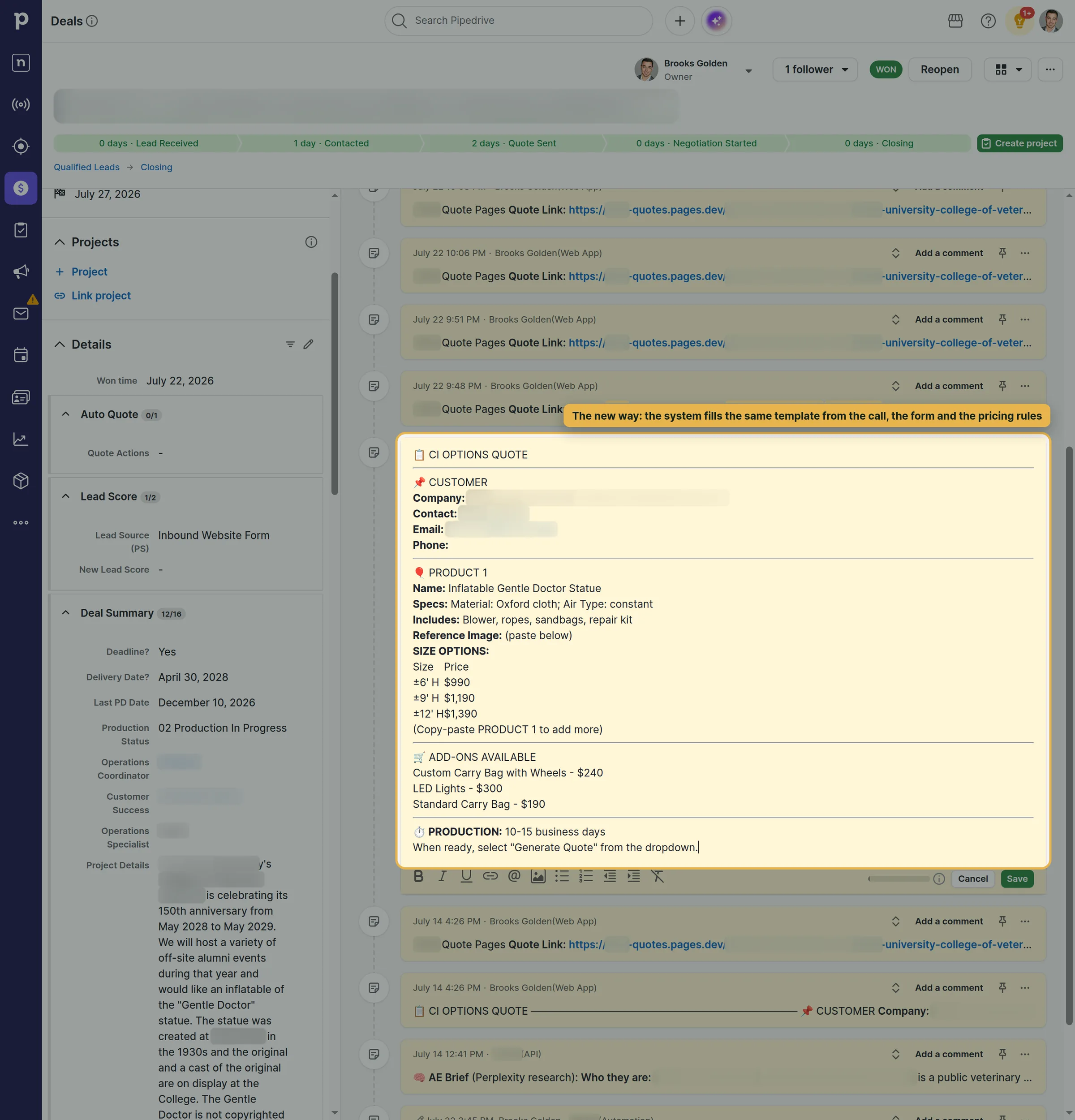
Starts from the call transcript, the form and the pricing rules. Picks standard or options, fills the same template, attaches the reference image, and publishes a quote page with its own link.
Result
Quotes can go out the same day as the call, priced by the same rules every time. The automation alone published 328 quote pages from June 3 to September 18.
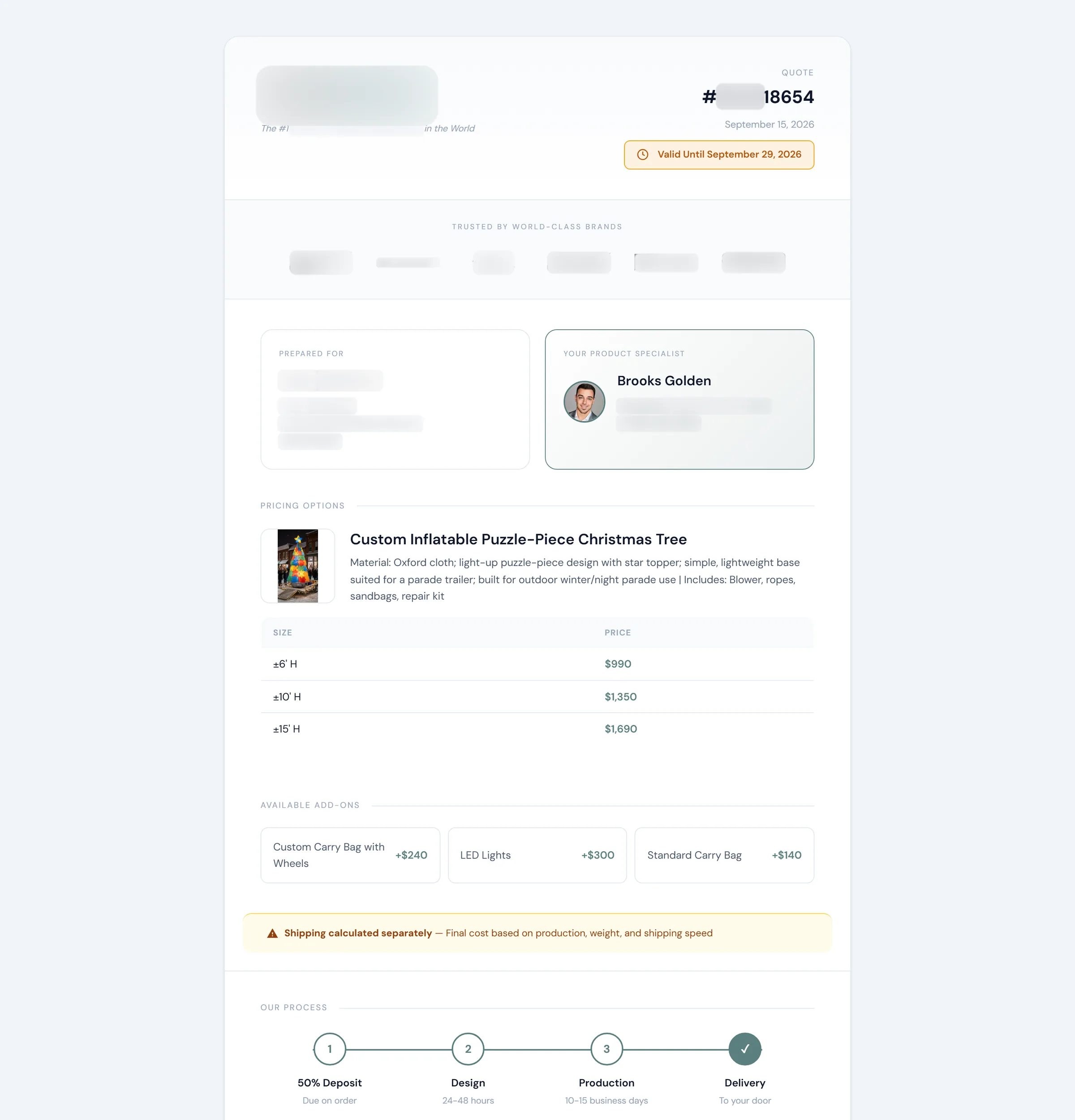
Every quote in 1 searchable database
Every quote page lands in 1 index: date, rep, customer, type, line items, materials and deal number. When a customer asks for the same thing as a past order, the answer is a search away.
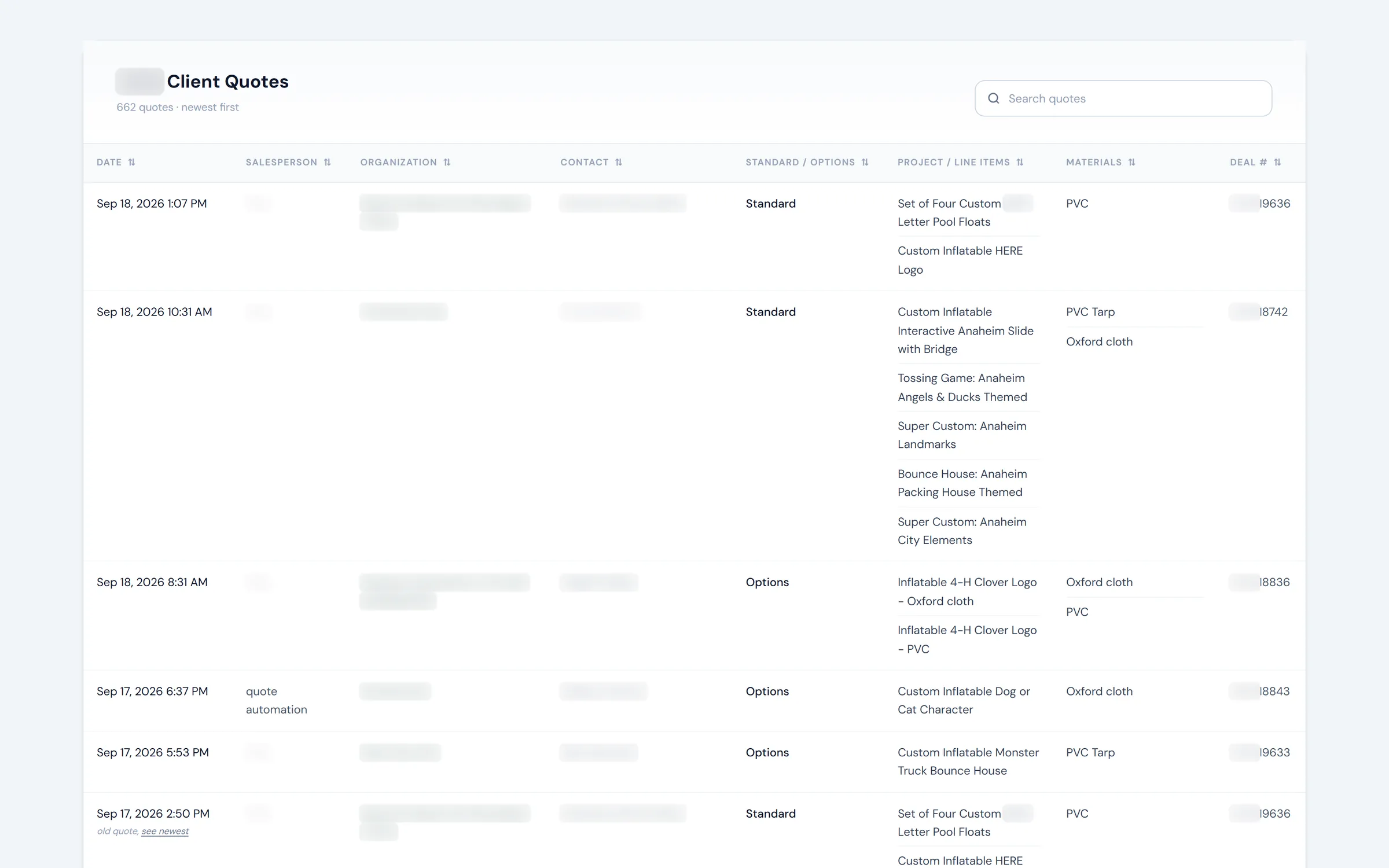
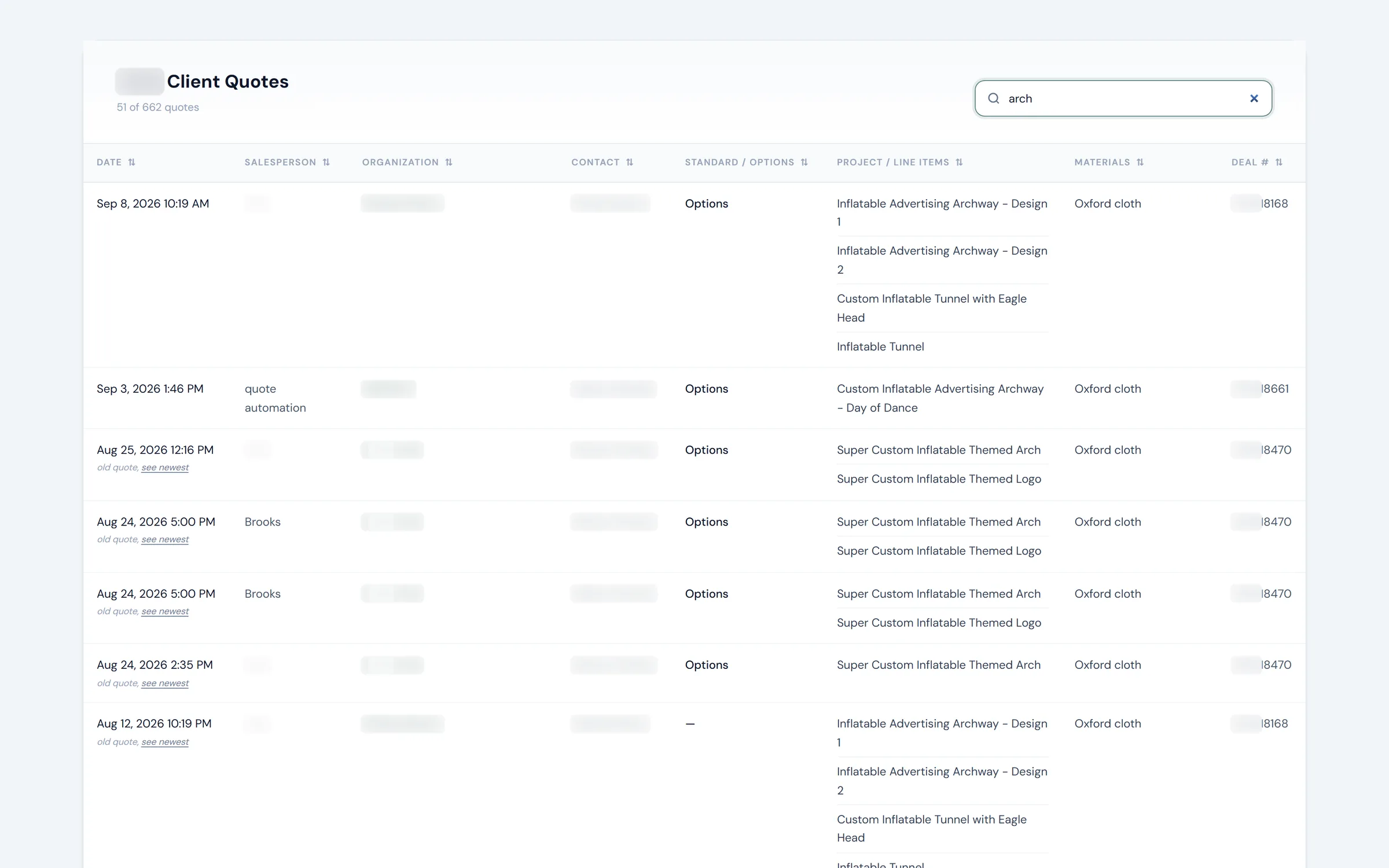
The tool spread: it was packaged for a second salesperson, who produced 269 quote pages with it between June and September. When another rep adopts a tool, that is the clearest sign it was worth building.
Open the deal, and the reply is already written
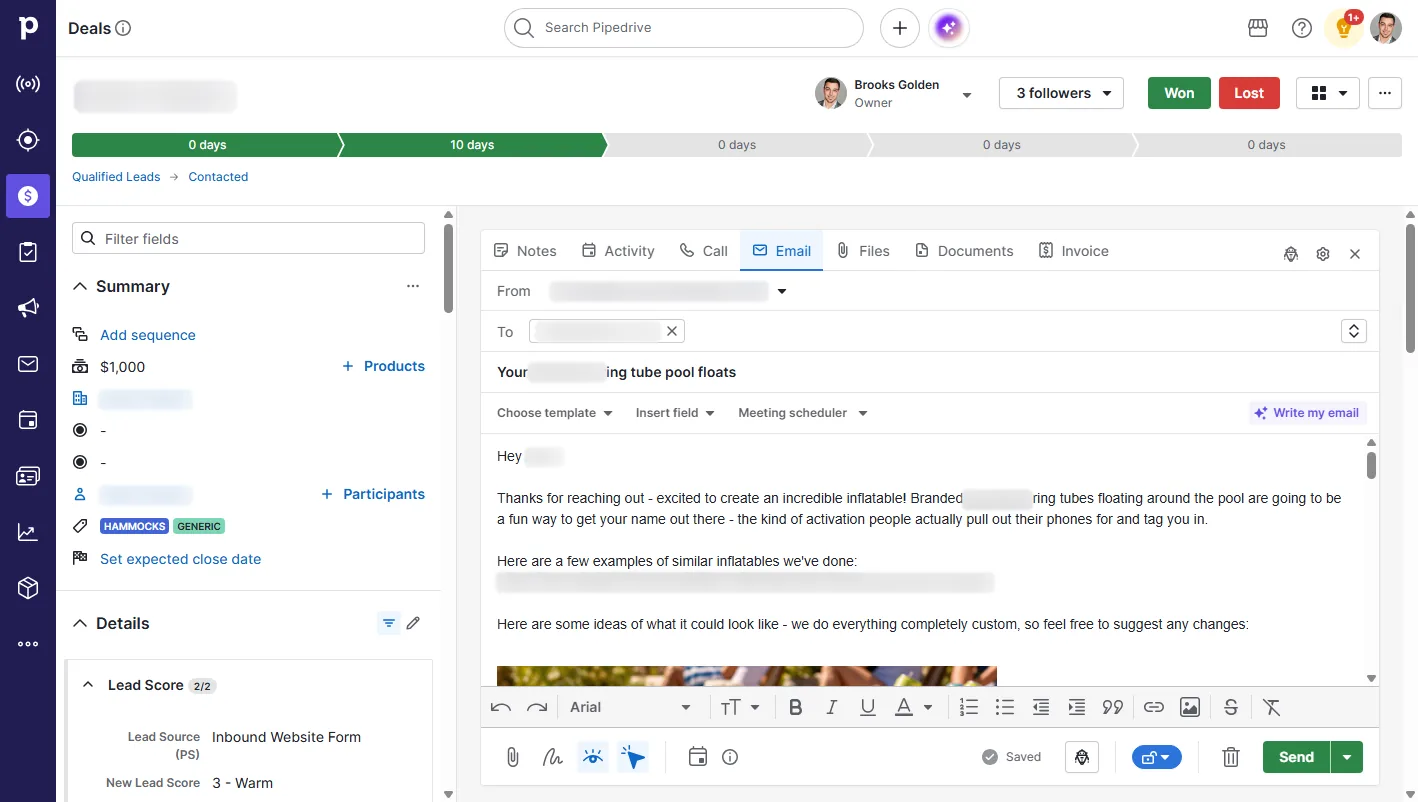
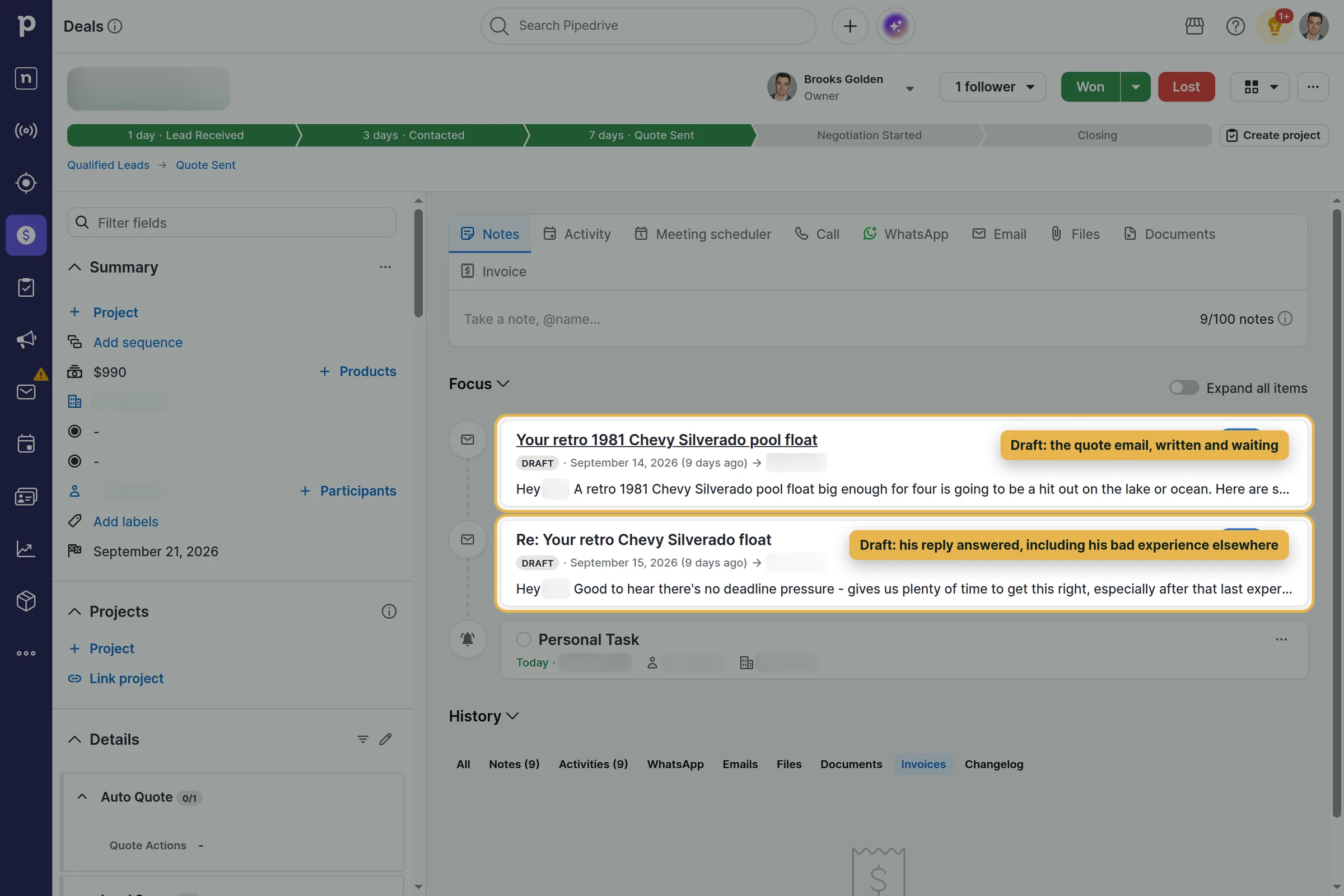
When a customer wrote back, the system read the whole deal, every email, call and quote, and saved a draft reply in the CRM for Brooks to check and send.
Before
Reread the thread, remember what was said on the call, find the quote, then write. With dozens of conversations open at once, replies slipped.
What the system does
Drafts the reply inside the deal with the full history in view, and knows which concept they picked or what they complained about. Brooks reviews before anything sends.
Result
Over 1,000 reply drafts from May to September. From late July, every customer email was also tracked against a 20-hour answer deadline.
Nothing slips through the cracks
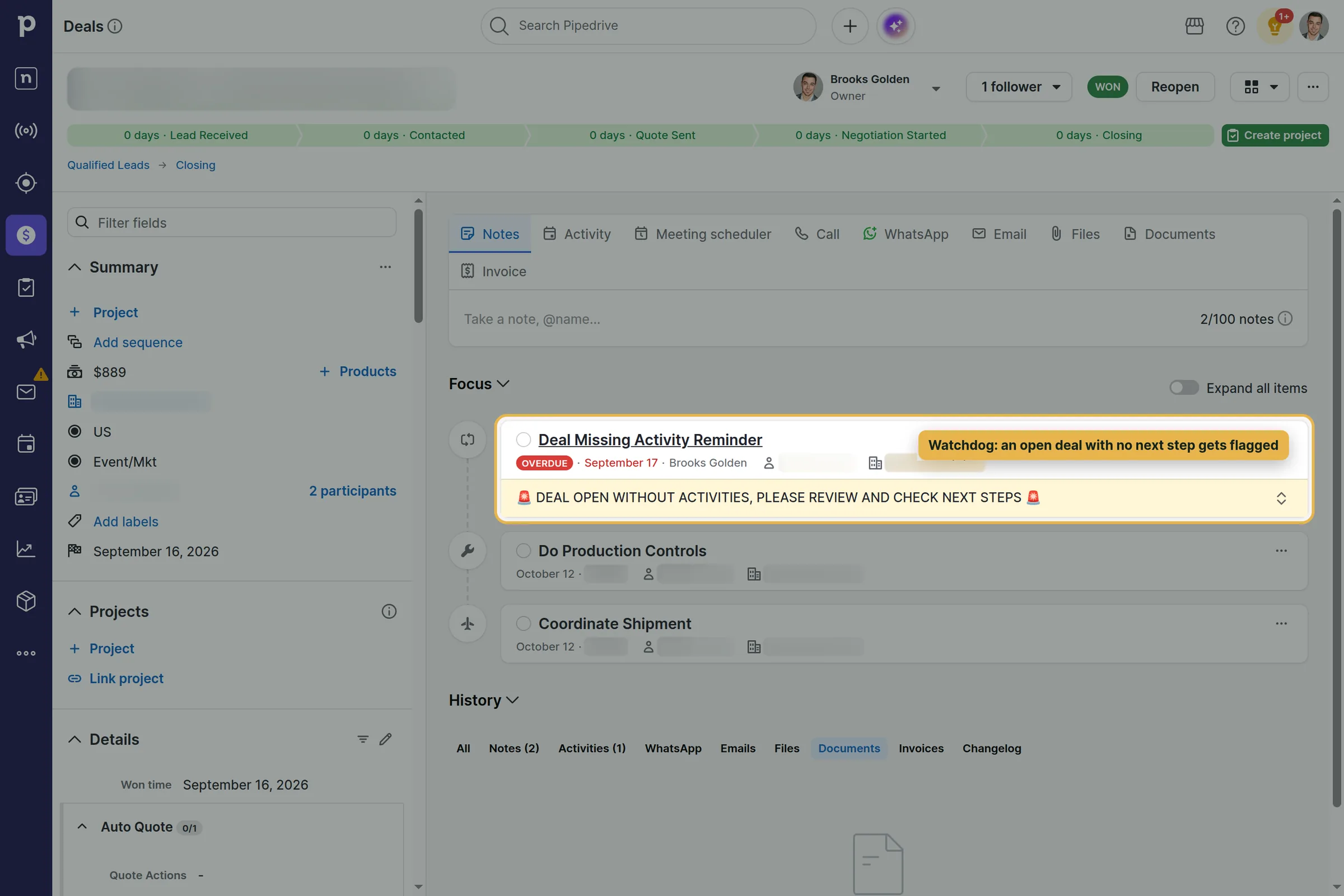
Deals die in the middle. Every stage ran on a follow-up cadence, and watchdogs checked every deal for a next step and every customer email for an answer.
Before
Follow-up from memory. A quiet deal surfaced weeks later, if at all.
What the system does
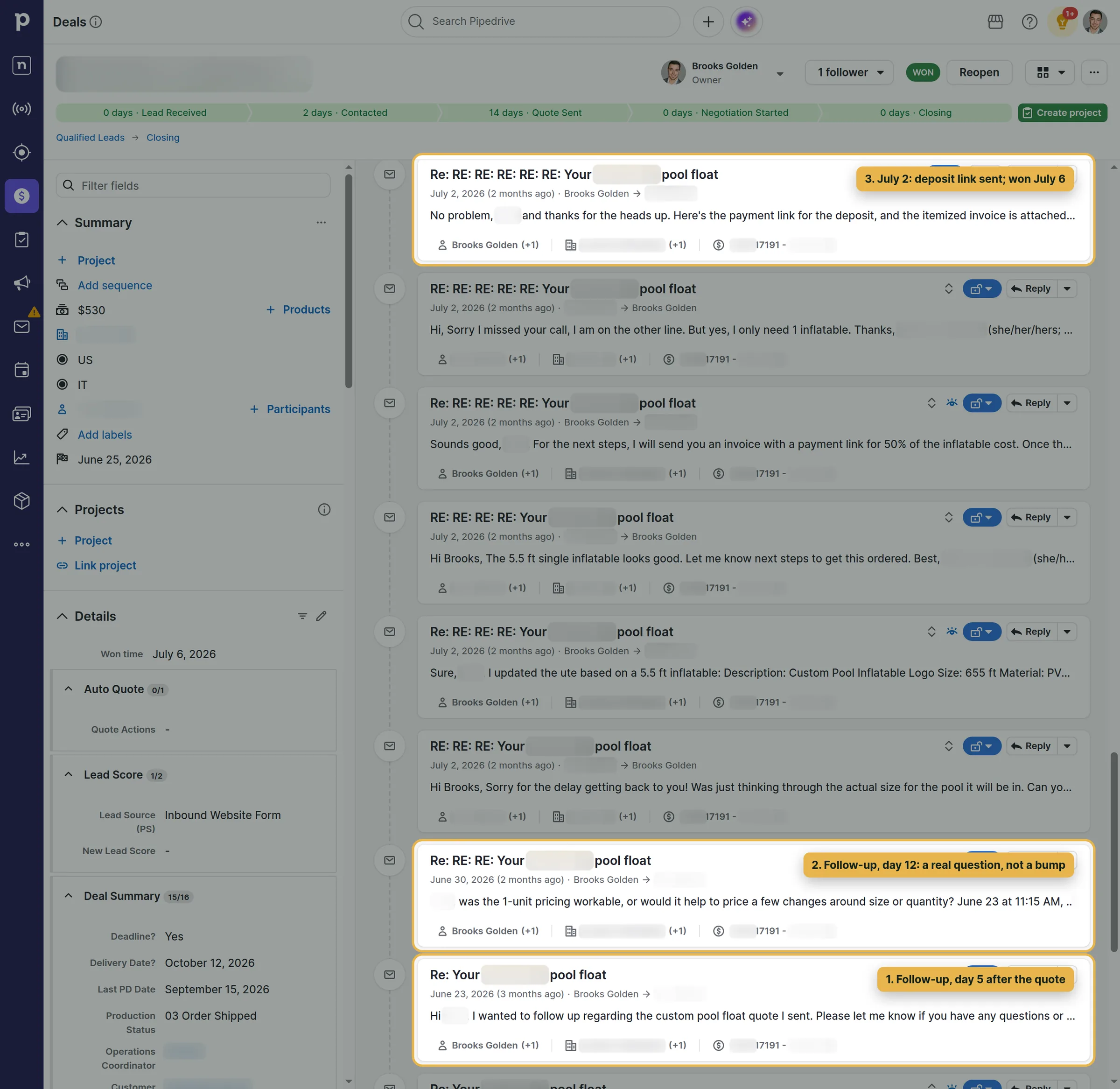
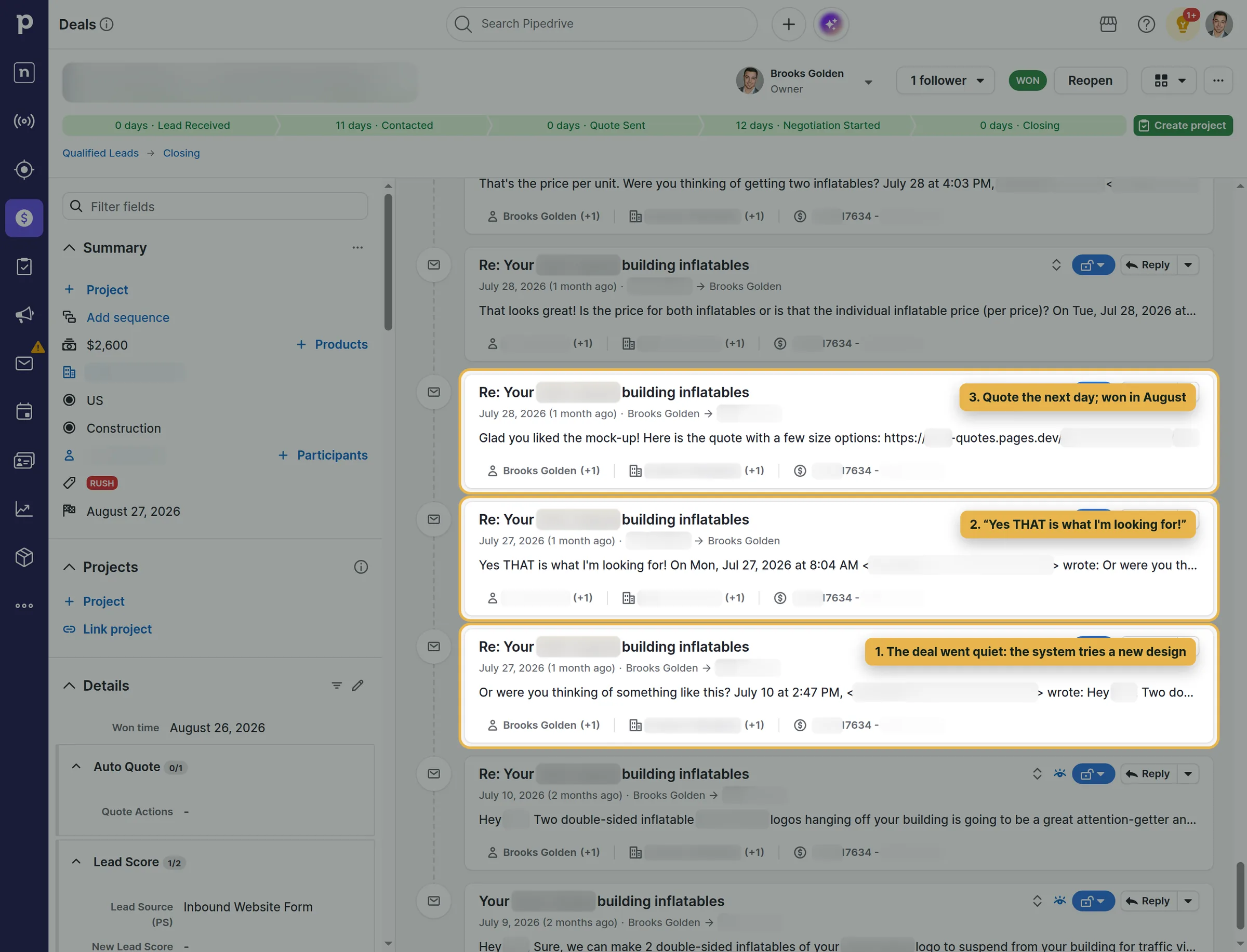
Stage-based follow-ups at set intervals, sent on weekdays in the hours people reply, stopped the moment the customer answers. A watchdog flags any open deal with no next step. Quiet deals get a genuinely new idea, not a bump.
Result
1,509 follow-ups scheduled from April to September: 460 sent automatically and 875 drafted for Brooks to approve.
The reminder to pick up the phone
“What builds relationships? Actually getting on the phone with the customer.” Email closes sales; calls build relationships. So the system made sure the call happened.
Before
Calls got crowded out by admin. The easy path was 1 more email.
What the system does
24 hours after a new lead, if the customer had not replied, it writes a note on the deal: call or text them, with the text already written, and labels the deal so it stands out.
Result
78 call reminders from July to September. 92 more were skipped because the customer had already replied.
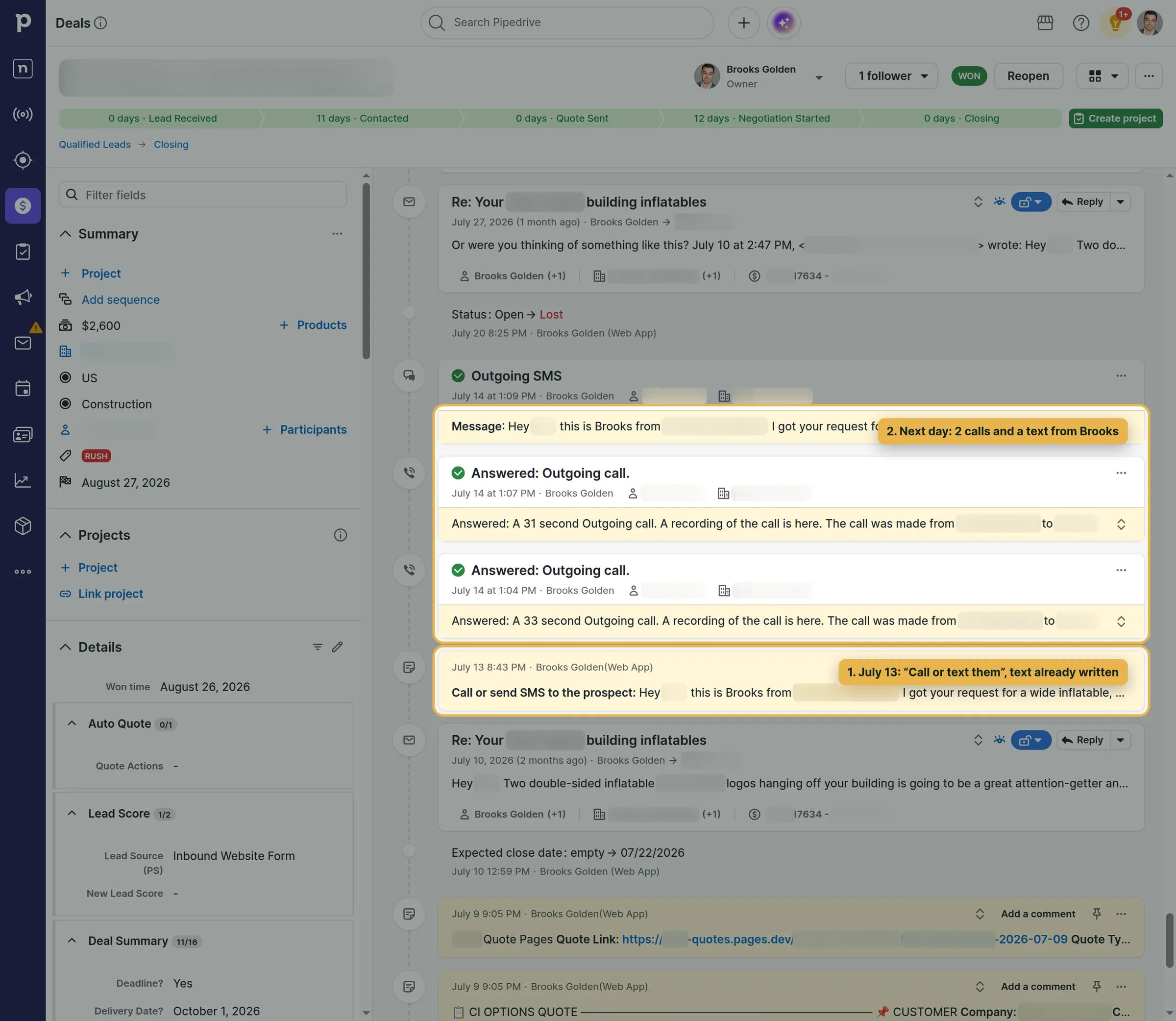
“There are a number of deals I closed just through email. You don't really build a relationship; you're just making a sale. Having automations that remind the account executive to get on the phone is powerful.”Brooks Golden
More data on every deal, without typing it
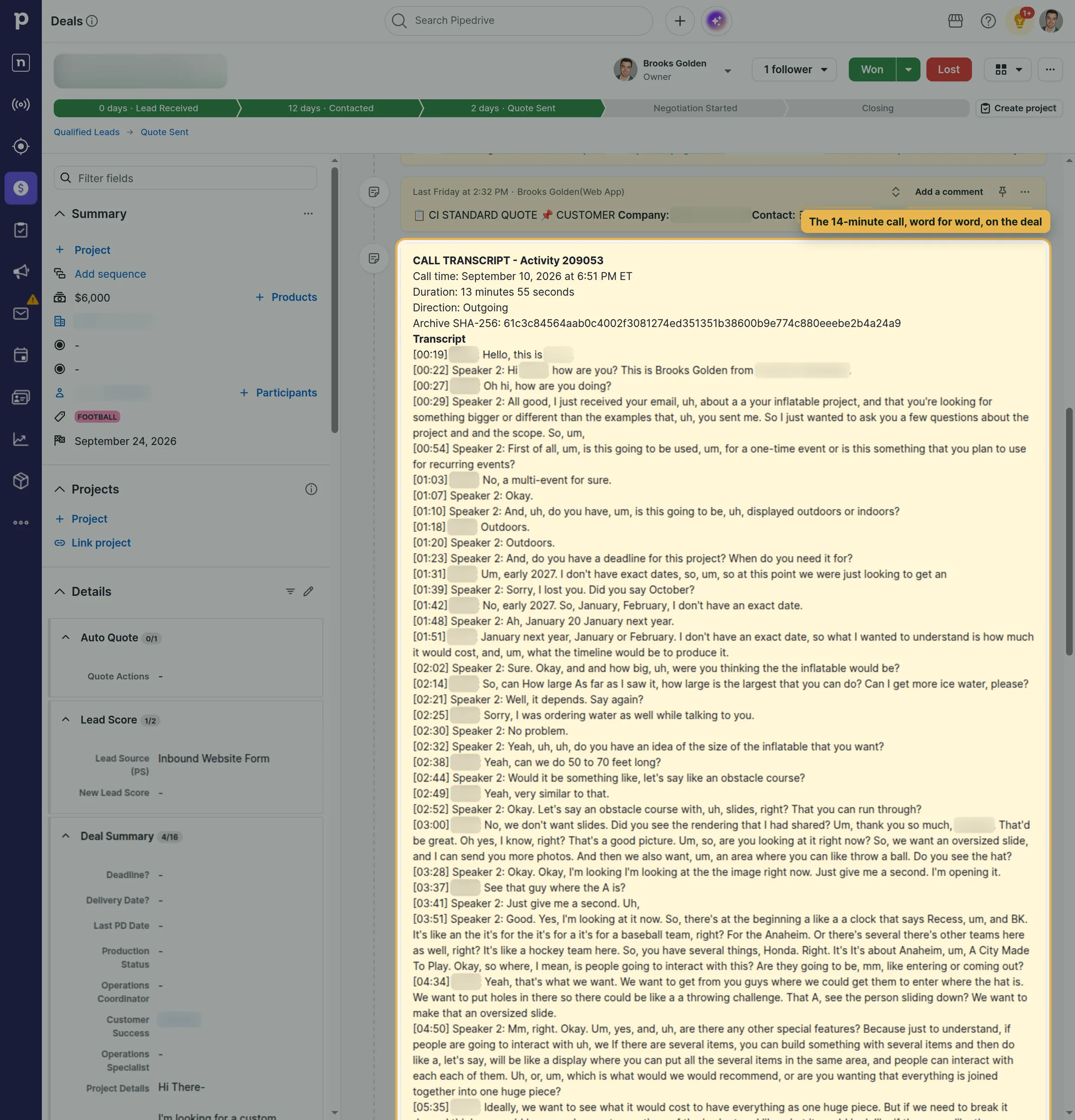
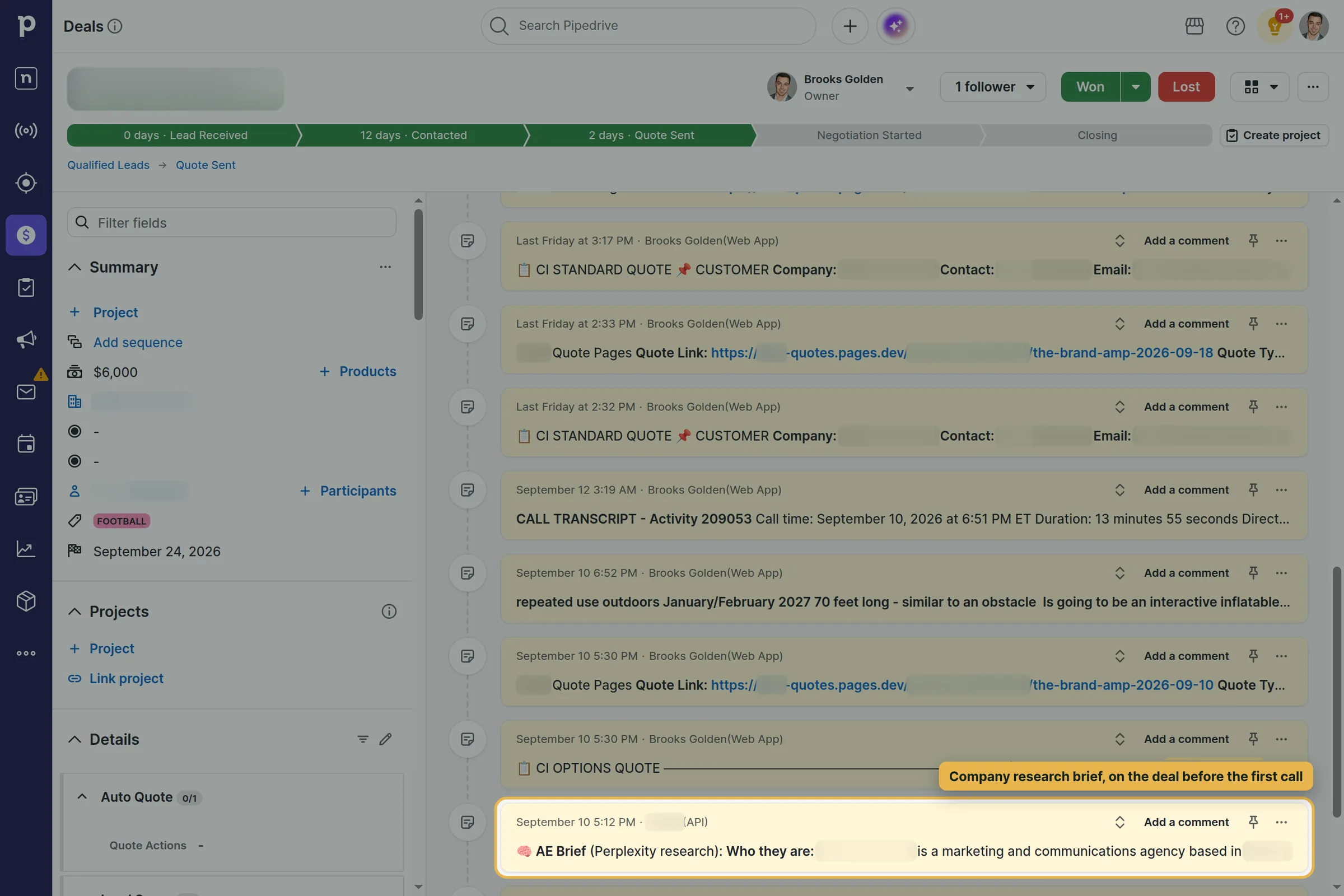
Calls were transcribed into the deal, companies were researched before the first call, and a running project summary kept every later step working from the same facts.
A pipeline that stays clean on its own
A clean pipeline is one you can trust at a glance: every open deal real, every date believable, every stalled deal either revived or closed out politely.
Close dates that mean something
Every weekday hour, a sweep moved expected close dates that had slipped past, so the forecast stayed honest.
Overdue work rolled forward
Activities left overdue were rolled to the next working slot instead of piling up red.
Labels that say who owes what
Hammocks: a draft is waiting on Brooks. Football: Brooks owes the customer an answer. Deadline flags for rush orders.
The handoff to customer service and production
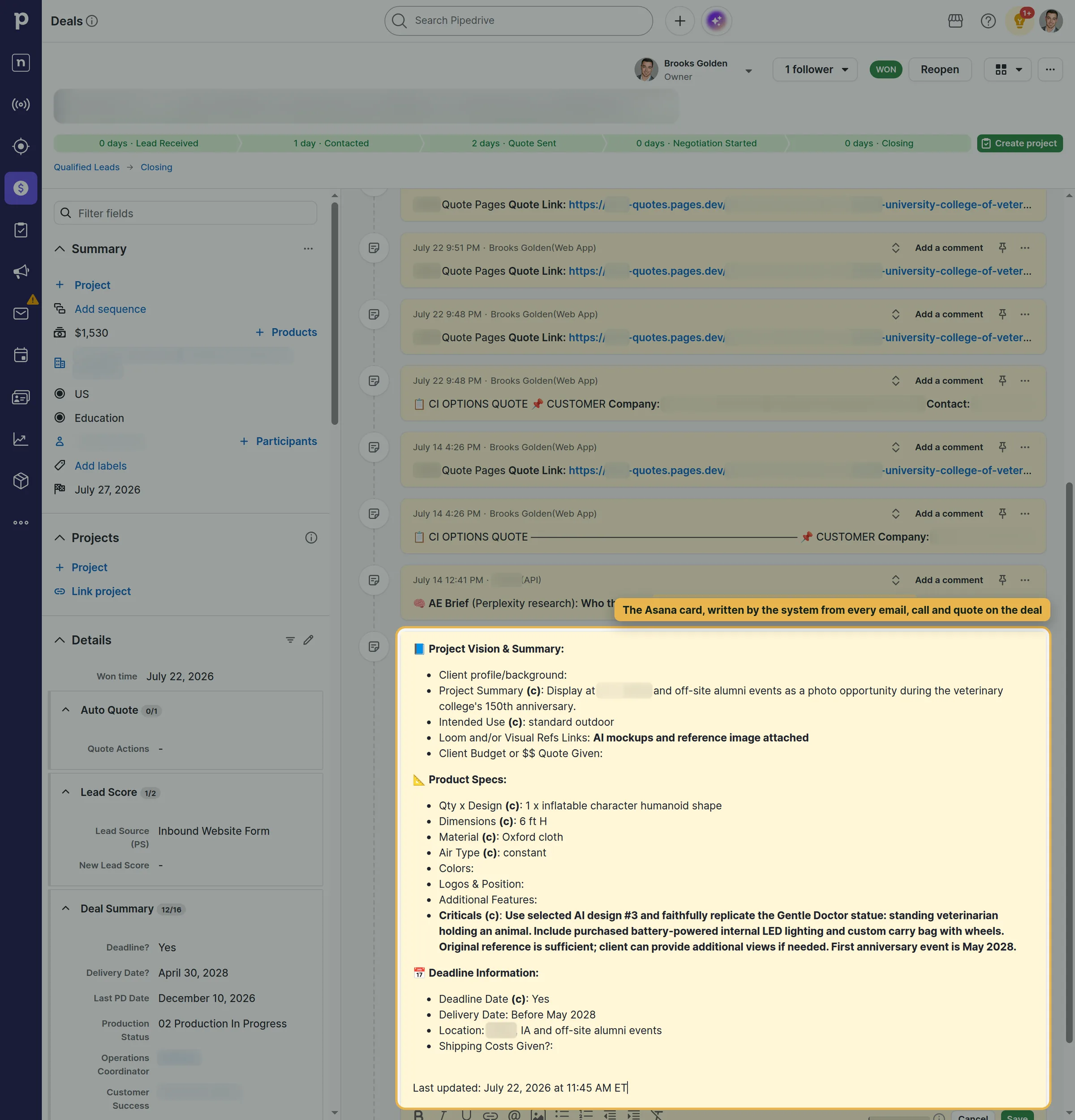
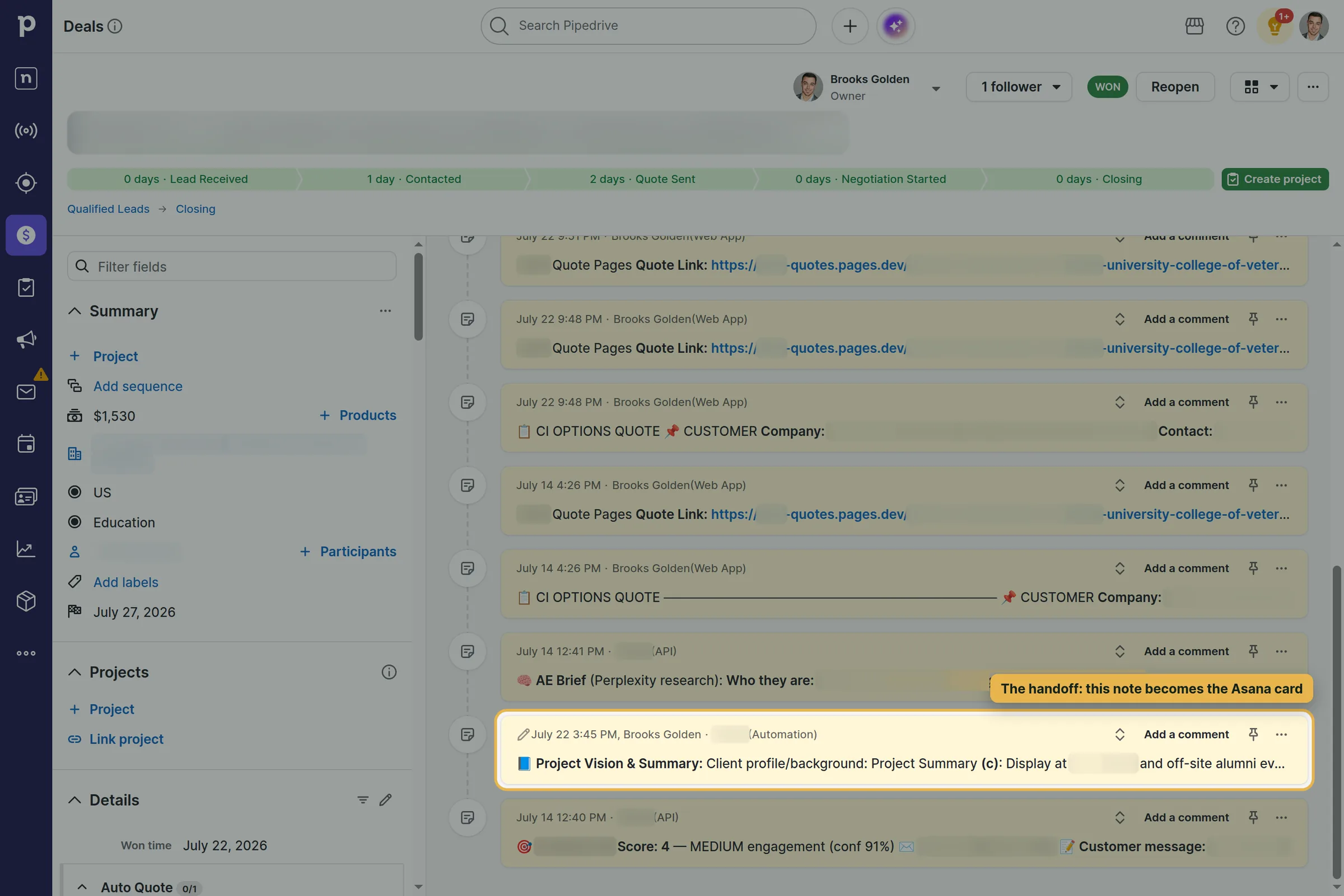
When a deal closed, the people building it needed everything: what was sold, the size, the material, the deadline, and every decision made along the way. The system wrote it into the Asana card for them.
Before
Rewrite the deal from memory for the production card, then again for the customer's handoff email.
What the system does
Keeps 1 Project Vision & Summary note on every deal, the Asana card, updated from the emails, calls, quote and chosen concept. On payment, a handoff email goes out with a shipping estimate.
Result
Production starts from the customer's actual decisions, like “use AI design #3”. 266 handoff emails drafted.
How it runs with no API
Without API access, the only way in was the screen. So the system got its own computer in the cloud, its own browser logged into the CRM, and a schedule. Every job uses the CRM the way a person would, then reloads the deal to prove the work landed.
You

The cloud server$25.59 / month









Where the work lands




Jobs that run at specific times
Timing is a feature. New leads are checked every minute during business hours, overnight replies wait for 8 am, follow-up drafts are written at night so they are ready in the morning, and the repair crew works on a fixed cadence so it doesn't burn through AI usage.
Weekdays, Eastern time. 42 jobs in total; the main ones are shown.
Who fixes it when the screen changes
Working through a screen is fragile: buttons move, a draft can look saved and not be, 2 jobs can reach for the same browser. The answer was a small AI crew with separate jobs, and 1 rule above all: a task is only done when the result is confirmed on a fresh load of the deal.
Switching between Claude and Codex with 1 command
Every AI task has a named slot and a tier: routine work on cheaper models, reviews and repairs on the strongest. 3 profiles decide who fills each slot, and 1 command moves the whole fleet. If 1 provider hits a usage limit, work continues on the other; only a dead login pages a human.
| Profile | Writing & routine checks | Architecture & repairs | When it was used |
|---|---|---|---|
| Claude | Claude Sonnet | Claude Opus | Default from Aug 20 |
| Mixed | Claude writes and reviews | Codex executes | Balanced load |
| Codex | GPT-5.6 Luna | GPT-5.6 Sol | Fleet default mid-year; always kept warm as fallback |
9,103 AI calls: 5,841 on Anthropic models, 3,262 on OpenAI models, plus Google image and transcription models.
7 months, from 1 tool to a system
The starting point: close rate 10.5%, 13th of 15. Everything by hand.
The first tool: a transcript parser that turns a call into a quote, an email and an image prompt. It saves 10 to 15 minutes per quote and proves the idea.
The cloud server goes up. Nothing else works without it.
The system goes live: first replies, concepts, quotes, follow-ups. Close rate 23.0%, 1st of 19. Calls start being transcribed (April 23); the repair board opens (April 27).
1st of 20 in May, 25.8% in June. Every AI call now logged. The searchable quote database opens June 3, and a second salesperson starts quoting with a packaged copy of the tool.
Median first reply: 35 minutes. Call reminders start July 3. Close rate 24.1%.
A dedicated repair agent joins the crew; reply drafts for every inbound email. Close rate 22.5%.
Last day. Brooks’ process: #1 of 17 for the year at 20.5%. The system was paused, not shut down.
Different product, same pattern
A firm's week has the same shape: inquiries to answer, proposals to price, documents to chase, questions to answer from a long history, and handoffs from the person who sold the work to the people who do it. This is what that looks like with the same approach.
New client inquiries answered the same hour with a reply about their situation, and the discovery call booked.
A clear preview of the deliverable: the engagement scope, the monthly close package, the checklist they will get.
Engagement letters and proposals drafted from the call transcript and your pricing rules, ready to review.
Every proposal searchable, so pricing stays consistent across partners and seasons.
Client emails answered in drafts from the full client history, reviewed by staff before sending.
Document requests, e-signatures and organizers chased on a cadence, with a watchdog on every deadline.
A prompt to call the client at the moments that build trust, not just another email.
Sales to onboarding to production, with every decision already written into your workflow tool.
And the part that matters most for firms: it does not depend on your software having an API. If a person can do it on the screen, the system can do it on the screen, safely, on a schedule, and prove it did.







Find the hours hiding in your firm's week
Keelwater starts with a baseline of where the time goes, then builds the system underneath it and measures the before and after, the same way this project was measured.
- Close rates: the company's monthly sales reports (February to August) and its year-to-date leaderboard (January 1 to September 30). Ranks for February to June come from the same reports.
- Reply speed and reply rates: 5,730 messages from the work mailbox, February to July 2026. Speed is measured on web-form leads with exact submission times.
- System counts: the server's logs and databases, April to September 2026. AI call counts are completed calls.
- Hours per day and minutes per quote are Brooks' estimates.
- Screenshots: taken inside the CRM on September 24, 2026, except the email editor (captured by the system on May 18). Customer names, emails, phone numbers and the company's name are blurred. Quote templates generated for this page were deleted afterwards.